
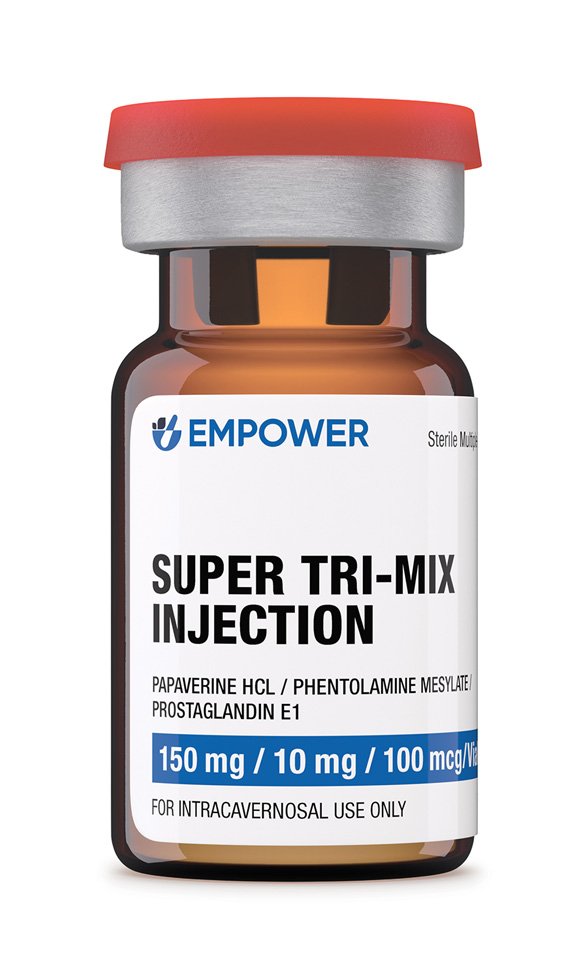
Tri-Mix Injection is a compounded prescription medication used to treat erectile dysfunction (ED), particularly in men who do not respond adequately to oral ED drugs like sildenafil or tadalafil. It is an injectable formulation containing three active ingredients: papaverine, phentolamine, and alprostadil (prostaglandin E₁). These agents work together to enhance blood flow to the penis, thereby facilitating the attainment of an erection. Unlike commercially manufactured ED medications, Tri-Mix is custom-made by compounding pharmacies for individual patients on a per-prescription basis under medical supervision. This means Tri-Mix is not an FDA-approved, mass-produced pharmaceutical product; instead, it is prepared in compliance with Section 503A of the U.S. Food, Drug, and Cosmetic Act as a bespoke formulation for a specific patient’s use. Clinicians may recommend Tri-Mix injection therapy when first-line oral treatments have failed, or even as part of penile rehabilitation protocols (for example, after prostate surgery) to help regain erectile function.
Tri-Mix injection has been in medical use for decades and is considered a well-established second-line therapy for ED¹. Intracavernosal injection treatments were first introduced in the early 1980s and gained global acceptance as an ED therapy by the 1990s⁵. Alprostadil (one of Tri-Mix’s components) was approved by the FDA in injectable form for ED in 1995, reflecting the long-standing clinical experience with this approach. For many men, Tri-Mix offers an effective alternative when oral medications are insufficient. Studies indicate a high success and satisfaction rate with injection therapy; about 70% of men report significant improvement and satisfaction using intracavernosal injections like Tri-Mix. Nevertheless, Tri-Mix must be prescribed by a qualified healthcare provider and initiated at an appropriate dose, as it requires proper administration technique and individualized dosing to achieve safe and optimal results. Because Tri-Mix is a compounded medication (not evaluated by the FDA for safety or efficacy as a unit), its use is typically reserved for patients under close medical oversight.
Tri-Mix injection dosing must be carefully individualized and is typically determined under a physician’s guidance. There is no single fixed dose for all patients; instead, the goal is to find the lowest effective dose that produces a satisfactory erection (one that is adequate for intercourse but not so prolonged as to cause harm). To achieve this, the initial dosing process usually involves a trial injection administered in a medical office setting. During this supervised session, a healthcare provider will start with a small test dose of Tri-Mix and monitor the resultant erection. A common starting dose might be on the order of 0.05-0.1 mL (depending on the formulation strength of the Tri-Mix), which is equivalent to 5-10 “units” on an insulin syringe. If this initial dose does not produce a sufficient erection, the dose can be titrated upward in small increments. For example, the prescriber may instruct the patient to increase the dose by about 0.05 mL (5 units) on subsequent attempts until the desired response is achieved. This stepwise approach helps ensure that the patient finds an optimal dose while minimizing the risk of an overly prolonged erection.
In practice, many physicians set a maximum volume limit, often around 0.5 mL (50 units) per injection, that should not be exceeded without re-evaluation. If a patient reaches the upper limit (for instance, 0.5 mL of a standard Tri-Mix formulation) with inadequate results, the provider might consider prescribing a stronger concentration of Tri-Mix rather than increasing the volume further. Frequency of use is strictly limited to reduce the risk of penile tissue damage: patients are generally advised to use Tri-Mix no more than three times per week, with at least a 24-hour interval between injections. Using Tri-Mix more often can significantly raise the risk of priapism and fibrosis. It is also recommended to alternate injection sides (left vs. right sides of the penis) each time to allow healing and prevent repeated trauma at one site. The injection is administered into the lateral aspect of the proximal third of the penile shaft, using a very fine needle (usually an insulin-type syringe). Proper training is essential: the healthcare provider will educate the patient on how to draw up the medication, locate an appropriate injection site, insert the needle at the correct depth, and inject slowly and steadily. After the injection, the patient should apply pressure to the site for a few minutes to prevent bleeding. By adhering to the prescribed dose and schedule, never exceeding the recommended amount or frequency, patients can safely use Tri-Mix over the long term. Any dose adjustments are done in consultation with the prescriber. In summary, Tri-Mix dosing is a careful balance: enough medication to reliably produce an erection, but not so much as to cause prolonged erections or adverse effects. This balance is achieved through conservative initial dosing, gradual titration, and strict limits on usage frequency.
Tri-Mix’s therapeutic effect is achieved through the synergistic action of its three pharmacological components, all of which promote penile smooth muscle relaxation and vasodilation. Papaverine is a vasodilator that works by relaxing smooth muscle in blood vessel walls. It inhibits phosphodiesterase activity and possibly voltage-gated calcium channels, leading to increased levels of cyclic nucleotides (cAMP, cGMP) in the penile tissuemediverarx.commenshealthalaska.com³. The resultant smooth muscle relaxation allows blood to flow more freely into the corpus cavernosum, helping produce an erection. Phentolamine, a nonselective alpha-adrenergic antagonist, complements papaverine’s effects by blocking alpha-1 and alpha-2 adrenergic receptors in the penile vasculature. By inhibiting the normal adrenergic signals that cause vascular smooth muscle contraction, phentolamine prevents vasoconstriction and thus facilitates further dilation of cavernosal blood vessels. The action of phentolamine therefore augments blood engorgement of the erectile tissue in response to sexual stimulation.
Alprostadil (PGE₁), the third component, is a prostaglandin analog that directly promotes vasodilation in the penis. Alprostadil binds to prostaglandin receptors on vascular and trabecular smooth muscle, triggering an increase in intracellular cyclic AMP and causing potent relaxation of the cavernosal arteries and sinusoidal spaces. This effect increases arterial inflow and expands the sinusoidal spaces, entrapping blood within the erectile tissue. The combined actions of papaverine, phentolamine, and alprostadil result in a robust erection by maximizing blood entry and retention in the penis. Importantly, because these drugs act locally at the site of injection, their systemic effects are limited (i.e., they primarily affect the penis rather than causing widespread vasodilation throughout the body).
Certain medical conditions and circumstances render the use of Tri-Mix injection inappropriate. Men who are advised against using Tri-Mix typically include those with predispositions to priapism (such as individuals with sickle cell anemia, leukemia, or other hypercoagulable states) or those with anatomical deformities of the penis (like significant Peyronie’s disease) that could complicate injection or increase the risk of injury. Tri-Mix should also be avoided in men for whom sexual activity is inadvisable due to cardiovascular or other health reasons (for example, men who have been warned against vigorous physical activity should not be engaging in sexual activity that requires an erection, whether induced by medication or not).
Active infections or open wounds on the penis are also contraindications for Tri-Mix use. Injecting through infected tissue could spread infection or lead to serious local complications. Additionally, anyone with a known hypersensitivity or allergy to any of Tri-Mix’s components (papaverine, phentolamine, or alprostadil) should not use the injection. In such cases, alternative treatments for ED must be explored. As always, the appropriateness of Tri-Mix therapy should be determined by a healthcare provider who can evaluate all patient-specific factors.
One advantage of Tri-Mix injection is that its action is largely localized to the penile tissue, resulting in minimal systemic drug interactions. Papaverine, phentolamine, and alprostadil primarily exert their effects at the site of injection with limited absorption into circulation. However, caution is still warranted when Tri-Mix is used in patients taking other medications that can lower blood pressure. The vasodilatory effect of Tri-Mix, though local, may additively contribute to hypotension if combined with systemic antihypertensive drugs. For example, co-administration of Tri-Mix with nitrates, alpha-blockers, or other vasodilators could potentially produce an exaggerated blood-pressure-lowering effect in susceptible individuals. Similarly, while Tri-Mix itself is not a phosphodiesterase type-5 (PDE5) inhibitor, combining a Tri-Mix injection with an oral PDE5 inhibitor (such as sildenafil or tadalafil) is generally not recommended unless explicitly directed by a physician. Using two ED therapies together can increase the risk of side effects like dizziness, hypotension, and priapism. Clinicians advise against using Tri-Mix and a PDE5 inhibitor on the same day; the patient should choose one form of therapy at a time.
If a transition between oral ED medications and Tri-Mix is necessary, a safe interval should be maintained between the two treatments. Guidelines often suggest waiting at least 18-24 hours after using a short-acting PDE5 inhibitor (such as sildenafil or vardenafil) before administering a Tri-Mix injection. In the case of longer-acting tadalafil, a longer separation (e.g. 48-72 hours) may be advised. This precaution is to ensure that the systemic vasodilatory effects of the oral medication have worn off, thereby reducing the risk of compounding hypotensive effects or an excessive erection response. It’s important to note that Tri-Mix has no significant interactions with food or most other drugs because it is not taken orally and bypasses the gastrointestinal and hepatic metabolism pathways. Nevertheless, patients should always inform their healthcare provider of all medications and supplements they are taking. Over the counter “natural” ED remedies (such as yohimbine or L-arginine) can also have vasodilating or blood pressure-lowering properties and combining them with Tri-Mix could theoretically increase risks⁷. In summary, while Tri-Mix’s local mechanism means drug-drug interactions are limited, concurrent use of other ED treatments or vasodilators can amplify systemic effects. Tri-Mix therapy should be coordinated by a physician, and patients are generally advised not to mix Tri-Mix with other ED medications or significant hypotensive agents unless under direct guidance, to avoid adverse interactions.
Like any invasive ED therapy, Tri-Mix injections can cause side effects, although most are mild and manageable. Because the injection is localized, the side effects tend to be primarily at the site of administration rather than systemic. Common local side effects include pain or aching in the penis, a mild burning sensation during or after the injection, and occasional minor bleeding or bruising at the injection site. Some men may also notice slight dizziness or flushing post-injection, but these systemic effects are typically transient and not severe.
More serious or long-term side effects of Tri-Mix are rare but can occur, underscoring the importance of proper technique and dosing. The most significant risk is priapism, a prolonged erection lasting longer than desired. Tri-Mix, like other ED injection therapies, carries a risk of inducing an erection that doesn’t subside (priapism), which is a medical emergency if erection duration approaches or exceeds 4 hours. Patients are carefully instructed on the signs of priapism and the steps to take (such as taking an oral decongestant at the 2-hour mark or seeking emergency care if 4 hours is reached) to mitigate this risk. Fibrosis (the development of fibrous scar tissue) within the penile tissue is another potential long-term complication from recurrent injections. Over time, repeated injections (especially if not spaced properly or if done in the exact same location each time) can lead to the formation of scar tissue in the penis, which might cause curvature or difficulty achieving an erection (like Peyronie’s disease). To minimize this risk, patients are advised to alternate injection sites on the penis and limit the frequency of injections as directed by their physician. Proper aseptic technique is crucial as well; injecting in a clean manner helps prevent infections or abscesses at the injection site. Overall, when Tri-Mix is used as instructed, the side effects are usually manageable and reversible, and serious complications are uncommon.
Tri-Mix Injection is intended for use only in male patients and has no indication or role in female sexual dysfunction. Consequently, its use by a man does not directly affect a female partner’s health in the way that an oral medication might (since the drug is delivered via injection into the man’s penis and acts locally). However, because Tri-Mix is not intended for use in women and has not been studied in pregnant women, there are general precautions recommended for sexual activity if a partner is pregnant or trying to conceive.
It is also worth noting that because Tri-Mix is not used by women, there are no direct teratogenic (birth defect-causing) concerns for a fetus from the medication itself. Nevertheless, many prescribing guidelines advise using a condom if the male patient’s partner is pregnant, primarily to ensure there is no theoretical risk of transferring any medication to the partner¹¹. This recommendation is largely out of an abundance of caution; for example, prostaglandin E₁ (alprostadil) can cause uterine contractions if significant exposure occurs, so avoiding even a remote chance of the drug affecting a pregnant partner is prudent. In the absence of direct contact or exposure (since Tri-Mix acts locally and isn’t excreted in semen in meaningful amounts), the risk is minimal, but healthcare providers often err on the side of safety. As always, any concerns about reproductive risks should be reviewed with a healthcare provider.
Proper storage of Tri-Mix is critical to maintain its stability and potency. As a compounded sterile preparation that often contains the unstable prostaglandin alprostadil, Tri-Mix should be kept refrigerated under most circumstances. The medication is dispensed as a lyophilized (freeze-dried) powder that must be reconstituted. If Tri-Mix is in liquid form, it must be stored in the refrigerator at 2-8 °C (36-46 °F) when not in use. It should not be left at room temperature for extended periods, as warmth can rapidly degrade alprostadil and reduce the medication’s effectiveness. In contrast, unopened freeze-dried Tri-Mix powder can be kept at room temperature until it is mixed with diluent; once reconstituted into liquid, it then requires refrigeration for preservation¹³. Patients who are traveling with Tri-Mix need to plan accordingly by using an insulated cooler or ice pack to keep the medication cold during transit. Tri-Mix should not be frozen (unless explicitly instructed by the pharmacy) because freezing and thawing might alter its components but keeping it chilled is essential.
In addition to temperature control, Tri-Mix vials should be protected from light and kept in a clean, dry place. Before each use, patients should inspect the vial: the solution should be clear to slightly yellow and free of any particles. If the Tri-Mix liquid becomes cloudy, develops precipitates, or changes color significantly, it may be contaminated or chemically degraded and should not be used. The patient should then obtain a new vial from the pharmacy. It’s also important to note the beyond-use date provided by the compounding pharmacy; Tri-Mix may only be stable for a certain number of weeks or months depending on its formulation and storage conditions. Using it past that date is not recommended due to potential loss of potency. Each vial is multi-dose, and the rubber stopper should be wiped with alcohol before each needle insertion to maintain sterility¹³. Needles and syringes are single-use only and should be discarded in a proper sharp’s container after injection. By following these storage guidelines, patients can ensure that their Tri-Mix remains effective and safe for its intended shelf life. Improper storage (for example, leaving Tri-Mix out of the fridge for extended periods) can lead to decreased efficacy of the medication and unpredictable results. Thus, maintaining the cold chain and handling the medication carefully are key parts of Tri-Mix therapy.