Tesamorelin is a synthetic peptide consisting of 44 amino acids. It is a stabilized version of the natural GHRH produced in the hypothalamus.
Drug Class: Growth Hormone-Releasing Hormone (GHRH) Analogue.
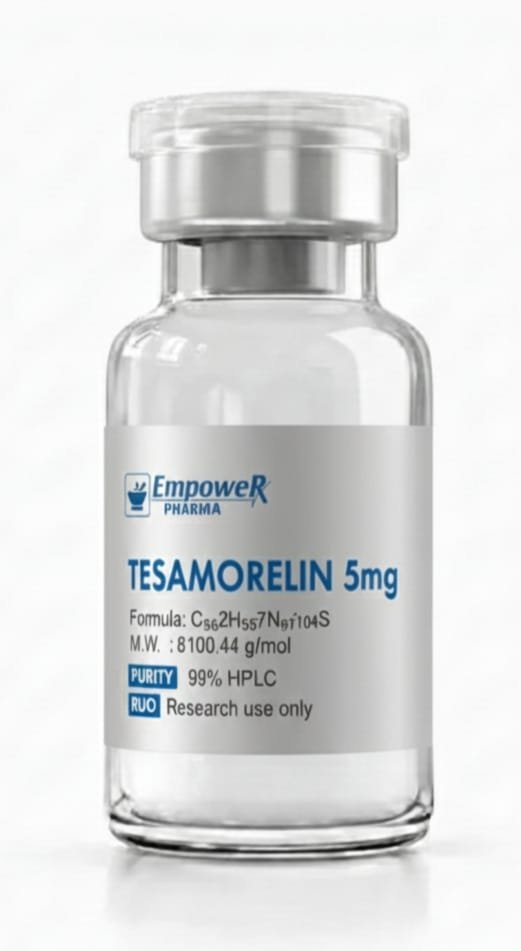
Molecular Weight: ~5135 g/mol (Note: The label in your image shows a different M.W., which may refer to a specific salt or complex version, or a labeling variation).
Half-life: Approximately 26 to 38 minutes.
Route of Administration: Typically administered via subcutaneous injection.
Tesamorelin mimics the action of the body’s natural GHRH to stimulate the production and release of Growth Hormone (GH).
The Biological Pathway:
Binding: Tesamorelin binds to the GHRH receptors on the somatotroph cells in the Anterior Pituitary Gland.
GH Release: This binding triggers the synthesis and pulsatile release of endogenous Growth Hormone.
IGF-1 Production: The increased levels of GH then circulate to the liver and other tissues, stimulating the production of Insulin-like Growth Factor 1 (IGF-1).
Physiological Effects:
Lipolysis (Fat Breakdown): The primary clinical goal of Tesamorelin is its effect on adipose tissue. Growth Hormone breaks down triglycerides and reduces visceral adipose tissue (VAT), which is the “deep” fat stored around abdominal organs.
Metabolic Regulation: Unlike synthetic Growth Hormone injections, Tesamorelin maintains the natural feedback loop of the body, which helps preserve the natural “pulses” of hormone release.

Primary Use: Reduction of excess abdominal fat in HIV-infected patients with lipodystrophy.
Important Note: The label in your image specifies “RUO – Research Use Only.” This means this specific vial is not manufactured for human clinical use and is intended for laboratory research settings.
Side Effects: Common side effects include injection site reactions (redness, itching), joint pain (arthralgia), and swelling (edema). Because it increases IGF-1, it must be monitored closely for its impact on blood sugar/glucose intolerance.