Bi-Mix Injection is a compounded intracavernosal formulation that combines papaverine hydrochloride, a peripheral vasodilator, with phentolamine mesylate, a non-selective α-adrenergic antagonist, to facilitate penile smooth-muscle relaxation and rapid arterial inflow for the treatment of erectile dysfunction in appropriately selected adult males. Compounding under section 503A allows customization of concentration and excipients so that clinicians can match pharmacodynamic needs to individual vascular responsiveness while remaining within a patient-specific prescription paradigm.
Unlike branded alprostadil monotherapy, Bi-Mix contains no prostanoid; therefore, its clinical profile may favor patients who experience prostaglandin-related penile burning or fibrosis. Papaverine raises intracellular cyclic adenosine monophosphate (cAMP) via phosphodiesterase inhibition, whereas phentolamine produces competitive blockade of cavernous α-receptors, preventing sympathetically mediated vasoconstriction. Together they may achieve erections within 5-15 minutes and typically sustain rigidity for up to one hour, provided cavernous veno-occlusion is intact.
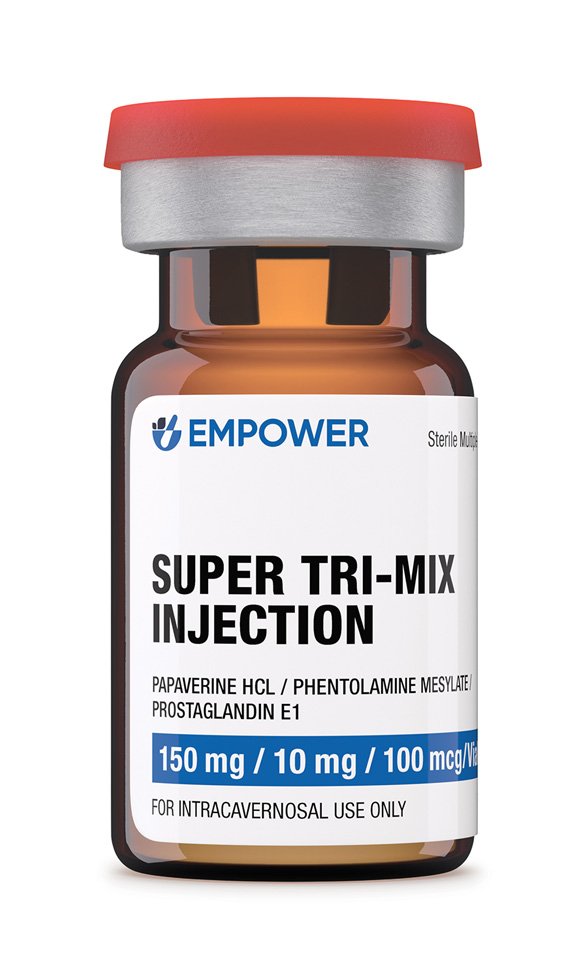
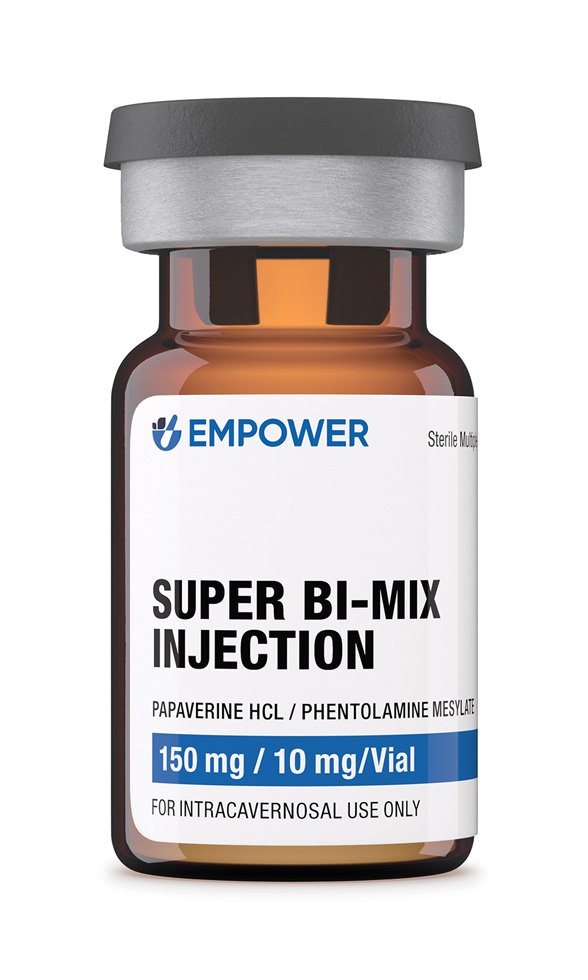
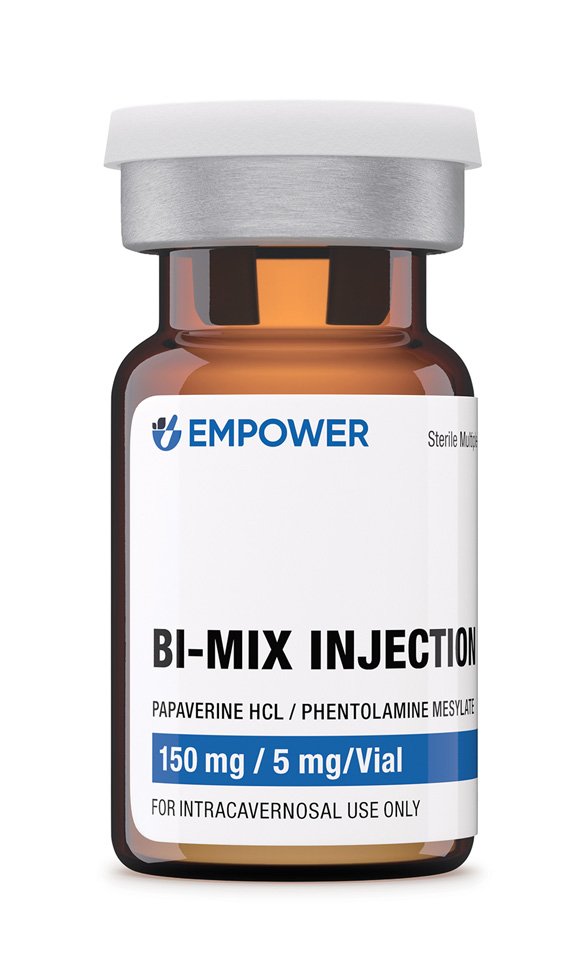
The preparation is supplied as a lyophilized powder in two strengths. Standard Bi-Mix yields 30 mg papaverine / 1 mg phentolamine per mL after reconstitution (150 mg / 5 mg per vial). Super Bi-Mix yields 30 mg / 2 mg per mL (150 mg / 10 mg per vial). Concentrations may be further diluted with bacteriostatic saline to individualize titration schedules under pharmacist guidance.
incremental 0.05 mL increases per clinic visit until an erection sufficient for penetration is achieved and sustained for no longer than 60 minutes; the mean effective dose approximates 15-20 mg papaverine with 0.5-0.7 mg phentolamine.
Pharmacokinetic modelling shows that papaverine reaches steady cavernosal tissue levels within eight minutes and decays bi-exponentially, allowing safe home injection every 48-72 hours; phentolamine’s shorter systemic half-life supports reuse after 24 hours, but compounding policies endorse a maximum of three injections weekly to limit cumulative tissue exposure.
Papaverine’s spasmolytic effect stems chiefly from non-selective inhibition of phosphodiesterase isoenzymes leading to accumulation of cAMP and, to a lesser degree, cyclic guanosine monophosphate (cGMP); both second messengers lower intracellular calcium and uncouple actin-myosin cross-bridging in corporal trabeculae. In vitro strips of rabbit corpus cavernosum demonstrate dose-dependent relaxation even after neural field stimulation is suppressed, underscoring a direct myocellular target.
Phentolamine complements this pathway by competitively blocking post-junctional α₁-receptors and pre-synaptic α₂-receptors, thereby diminishing tonic sympathetic outflow and facilitating unopposed parasympathetic vasodilation; coronary and peripheral data reveal pronounced reductions in vascular resistance without triggering significant venoconstriction.
When administered together, papaverine’s cyclic nucleotide surge heightens the effect of α-blockade, producing a synergistic increase in corporeal arterial inflow and sinusoidal expansion; clinical crossover studies report improved rigidity scores and reduced escape of venous blood versus either drug alone.
Historical investigations of intracavernosal injection therapies trace the pivotal role of papaverine/phentolamine combinations in shifting erectile dysfunction management from rigid vacuum devices toward pharmacologic auto-injection, markedly improving spontaneity of sexual activity in multicenter cohorts.
Current compounding practice leverages pharmacopeial data showing reliable dissolution kinetics and predictable onset within 10 minutes at reconstituted concentrations between 15 mg / 0.5 mg mL⁻¹ and 30 mg / 2 mg mL⁻¹; average half-life of papaverine in plasma remains roughly 2 hours, whereas phentolamine’s hemodynamic influence dissipates within 30-90 minutes.
Bi-Mix Injection should not be prescribed to patients with hypersensitivity to either component or to those with active myocardial ischemia, ventricular arrhythmias, or poorly controlled hypertension, because papaverine’s vasodilatory burden may precipitate reflex tachycardia or exacerbate cardiac oxygen demand.
Phentolamine is contraindicated in recent myocardial infarction, coronary insufficiency, or evidence of peptic ulcer disease owing to potential provocation of histamine release and gastrointestinal hyperemia; post-infarction patients exhibit exaggerated hypotensive responses that could compromise coronary perfusion.
The most serious local complication is ischemic priapism-prolonged erection beyond four hours-which, if untreated, risks corporal fibrosis and permanent impotence; men under forty, those with high baseline peak systolic velocities, and those receiving initial test doses above 60 mg papaverine show the highest incidence rates.
Clinicians must also avoid use in individuals with anatomical penile deformities such as Peyronie’s disease or severe cavernosal fibrosis, where intracavernosal pressure gradients are unpredictable and the risk of tissue injury is magnified; international consensus statements recommend alternative modalities in such populations.
Product-specific interaction data are extrapolated from the individual actives. Concomitant administration of antihypertensives, particularly nitrates or calcium-channel blockers, can potentiate systemic hypotension because compounded papaverine already lowers peripheral resistance; staggered dosing is advised to maintain hemodynamic stability.
Phentolamine strongly enhances vasodilatory effects of phosphodiesterase-5 inhibitors (sildenafil, tadalafil, vardenafil), raising the possibility of syncope; combined use requires cautious micro-dosing and monitoring for additive priapism risk.
Clinical series employing adjunctive aviptadil have shown that layered vasodilators magnify erectile response but also increase incidence of post-injection dizziness and flushing, highlighting the need for formal titration protocols when introducing novel vasoactive peptides into an established Bi-Mix regimen.
Hepatic microsomal induction by chronic alcohol intake or anticonvulsants may accelerate papaverine metabolism, reducing efficacy; rodent models demonstrate up-regulation of glutathione-S-transferase and augmented clearance following repeated high-dose exposure, indicating that maintenance schedules may require upward adjustment in such contexts.
Common systemic effects include transient facial flushing, mild hypotension, light-headedness, and gastrointestinal discomfort. These events generally resolve within minutes as plasma concentrations fall and seldom necessitate therapeutic withdrawal.
Serious adverse outcomes comprise persistent erections, corporal pain, and, rarely, high-flow priapism. Case literature documents priapism following as little as 40 mg papaverine in a healthy 28-year-old male, underlining individual variability in alpha-receptor density and cyclic nucleotide handling.
Systemic dizziness or presyncope has been linked to inadvertent intracavernosal venous entry, leading to rapid systemic dispersal; men with veno-occlusive dysfunction require lower starting doses and mandatory office-based observation during the initiation phase.
Combination regimens that add prostaglandin E₁ may elevate injection-site discomfort and increase risk of cavernosal fibrosis if weekly cumulative papaverine exposure exceeds 600 mg, prompting guidelines to limit frequency to no more than three injections per week with 24-hour washout periods.
No clinical indication exists for use in pregnant individuals; however, inadvertent exposure data from a 254,000-pregnancy registry revealed no significant association between first-trimester papaverine intake for maternal biliary spasm and major congenital anomalies, though statistical confidence remains limited by low exposure prevalence.
Animal reproduction studies are inadequate; nonetheless, labeling information classifies papaverine solutions as Pregnancy Category C due to embryo-fetal toxicity observed at supratherapeutic doses in rodents, and it advises complete risk-benefit assessment before systemic use in women of child-bearing potential.
Refrigerated storage once reconstituted between 2 – 8 °C and protection from light therefore remain critical.
Lyophilized powder retains labeled strength at controlled room temperature below 25 °C when sealed under inert gas with pH adjusted to 2.2; ampoules stored under these conditions showed no significant hydrolytic breakdown or particulate formation during accelerated aging tests.