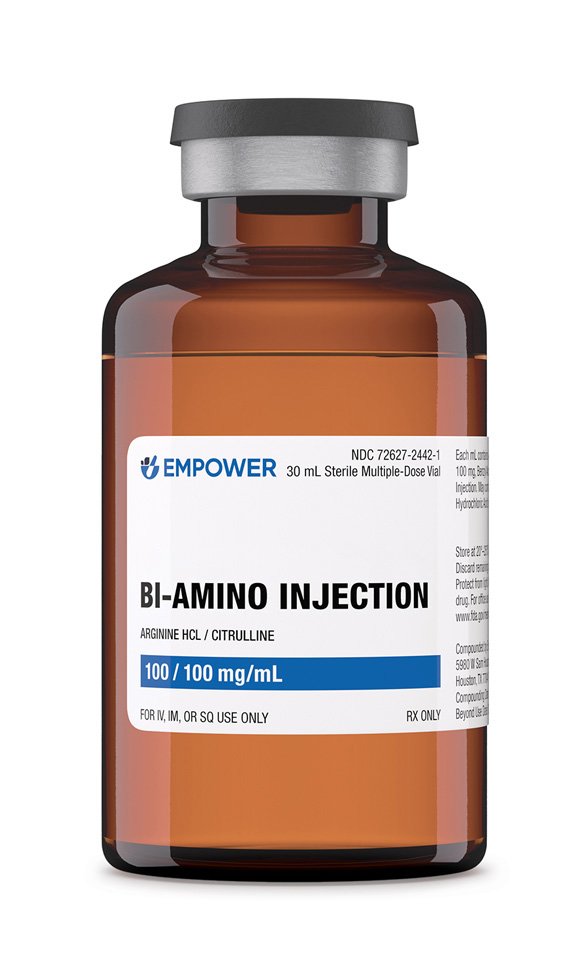
Bi-Amino Injection is a compounded sterile solution that delivers equimolar concentrations of L-arginine hydrochloride and L-citrulline-100 mg of each amino acid per milliliter-in a 30 mL preservative-free multidose vial. Compounding may occur in a 503A pharmacy for a named patient or in a 503B outsourcing facility for office use.
The formulation was created for clinical settings in which oral supplementation is impractical or where rapid, predictable plasma amino-acid levels are required, such as peri-operative cardiovascular optimization, growth-hormone stimulation testing, or specialized sports-medicine protocols.
The product must be prescribed and administered by qualified practitioners who can screen for contraindications, monitor real-time hemodynamics, and intervene promptly should infusion-related adverse events arise.
Patient-information materials should emphasize that Bi-Amino Injection is a compounded preparation that has not been reviewed by the Food and Drug Administration for safety or efficacy, and that ongoing laboratory assessment-electrolytes, acid-base status, and renal function-forms an integral part of therapy.
Bi-Amino Injection’s clinical rationale draws on pharmacokinetic evidence that intravenous arginine produces a sharp plasma peak followed by biphasic clearance, whereas citrulline bypasses splanchnic arginase activity, undergoes efficient renal conversion back to arginine, and sustains substrate availability for nitric-oxide synthase several hours beyond the initial infusion.
In combining both amino acids, the preparation may deliver rapid endothelial nitric-oxide substrate while prolonging systemic exposure, potentially enhancing vasomotor control, collagen deposition, and immunomodulatory nitrogen handling.
Formulators selected hydrochloride salt to mirror the acid-base characteristics of existing diagnostic arginine infusions but buffered the final product to physiological pH to lessen the transient hyperchloremic acidosis sometimes seen with large arginine-only boluses.
No consensus dosage exists for Bi-Amino Injection; protocols are extrapolated from endocrine testing and experimental vascular-support studies.
A common investigational regimen employs 0.5 g kg−1 of combined amino acids (maximum 40 g total), infused over 30 – 45 minutes with equal parts arginine and citrulline.
Lower maintenance doses-5 – 10 g of each amino acid two to three times weekly-have been explored in rehabilitation settings but remain unsupported by large outcome trials.
Central venous access is preferred for cumulative dosing above 20 g to avoid phlebitis, and continuous electrocardiography, non-invasive blood-pressure, and pulse-oximetry are minimum monitoring standards throughout and for at least 30 minutes after infusion.
At the biochemical level, L-arginine serves as the sole substrate for nitric-oxide synthase isoenzymes. In endothelial cells, arginine oxidation produces nitric oxide (NO) and L-citrulline; NO diffuses into adjacent smooth-muscle cells, stimulates soluble guanylate cyclase, increases cyclic GMP, and lowers intracellular calcium, culminating in vasorelaxation and anti-platelet effects.
The newly formed citrulline is rapidly recycled to arginine by arginosuccinate synthase and arginosuccinate lyase, making the arginine-citrulline-NO cycle a self-sustaining engine for endothelial homeostasis.
Exogenous citrulline augments this loop because it is not a substrate for arginase, allowing more efficient restoration of the intracellular arginine pool.
The dual-component design of Bi-Amino Injection therefore amplifies both the immediate NO burst and the longer-term replenishment of arginine stores, a synergy that may be valuable in conditions characterized by endothelial dysfunction, impaired wound healing, or increased oxidative stress.
Citrulline itself has demonstrable hemodynamic benefits that extend beyond substrate recycling.
Because it avoids hepatic first-pass metabolism, circulating citrulline is primarily cleared by the proximal renal tubule, where it is enzymatically converted to arginine.
Controlled trials reveal that chronic citrulline supplementation lowers peripheral and central systolic pressures, diminishes arterial stiffness indices, and improves skeletal- muscle perfusion during exercise rehabilitation.
When citrulline is co-delivered intravenously with arginine, the result is a smoother pharmacodynamic curve, mitigating rapid peaks and troughs in vascular tone that otherwise accompany arginine-only infusions.
Furthermore, citrulline participates in ammonia detoxification through the urea cycle, offering potential metabolic advantages in catabolic states with elevated nitrogen waste.
Bi-Amino Injection is contraindicated in patients with severe renal impairment, hepatic failure, baseline hyperkaliemia, or uncompensated metabolic acidosis. Case reports document life-threatening potassium elevations and fatal arrhythmias when arginine infusions were administered to individuals with diminished renal or hepatic clearance, illustrating that even short-duration dosing can overwhelm compromised excretory pathways.
Pre-infusion screening must therefore include a comprehensive metabolic panel, electrocardiography, and acid-base assessment. Dialysis dependence or an estimated glomerular filtration rate below 30 mL min−1 1.73 m−2 represents an absolute contraindication unless the infusion is placed immediately before dialysis under nephrology supervision.
Historical series in chronic-kidney-disease populations further underscore risk: moderate renal impairment alone predisposed recipients to potassium surges despite apparently normal baseline laboratory values.
Similar caution extends to patients on potassium-sparing diuretics, aldosterone antagonists, or angiotensin-receptor blockers, all of which blunt renal potassium excretion.
Severe liver dysfunction poses parallel concerns because urea-cycle capacity is impaired, potentially leading to hyperammonaemia and encephalopathy.
Finally, systemic acidosis worsens during arginine metabolism; thus, clinicians should withhold Bi-Amino Injection until arterial pH is stabilised above 7.30 to prevent compounded acid-base derangement.
Premarketing surveillance of parenteral arginine formulations identified nausea, vomiting, headache, flushing, numbness, and local venous irritation in approximately three per cent of infusions.
These adverse events are usually infusion-rate dependent and resolve with simple supportive measures such as slowing the drip, providing anti-emetics, or alternating cannula sites.
The addition of citrulline has not significantly altered incidence or severity, but formal head-to-head trials are absent, emphasizing the need for vigilant post-marketing reporting. Routine acid-base checks during high-dose regimens help detect the transient hyperchloremic acidosis that may underlie many subjective complaints of warmth and facial tingling.
Broader pharmacovigilance databases list rare but potentially serious events: rash, oedema, transient hypotension, hematuria, airway hyper-reactivity, and syncope.
The mechanism for bronchospasm remains speculative but may involve NO-mediated bronchiolar smooth-muscle relaxation tipping into paradoxical constriction in susceptible individuals.
Slow titration, dilution to isotonicity, and bedside resuscitation supplies are recommended precautions.
Dose-limiting toxicity has not been precisely defined in humans, yet practitioners should terminate infusions if severe dizziness, chest tightness, or abrupt blood-pressure drops occur, then reassess electrolyte status and acid-base balance before re- challenge.
Interest in amino-acid therapy during pregnancy stems from observations that impaired nitric-oxide bioavailability contributes to pre-eclampsia and fetal growth restriction.
Trials administering oral or intravenous arginine and citrulline have reported improvements in uteroplacental hemodynamics and gestational blood-pressure control, without documenting teratogenicity or major maternal complications.
Nevertheless, sample sizes are small and methodologies heterogeneous, leaving substantial uncertainty.
Bi-Amino Injection should therefore be considered only when potential maternal-fetal benefits clearly outweigh theoretical risks, and treatment should proceed in high-risk obstetric units where serial fetal surveillance and maternal laboratory assessment are feasible.
The compounded product should be stored at controlled room temperature (20 – 25 °C) and protected from prolonged heat, freeze-thaw cycles, or direct sunlight, all of which can degrade amino-acid integrity.