Branched-chain amino acids (BCAAs) – isoleucine, leucine, and valine – constitute almost one-third of the essential amino acids in human muscle protein and are unique in that their initial catabolism occurs largely outside the liver, permitting rapid systemic availability after parenteral administration.
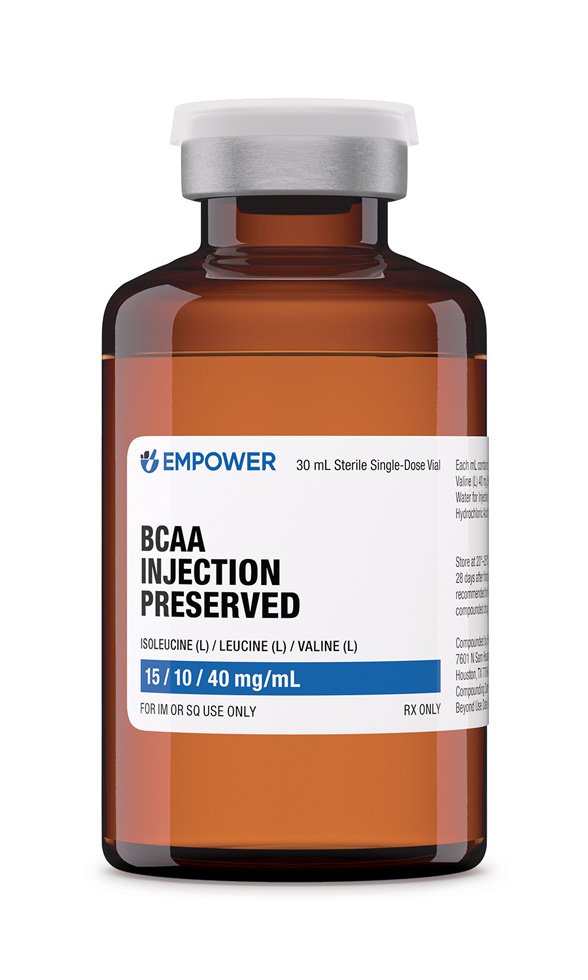
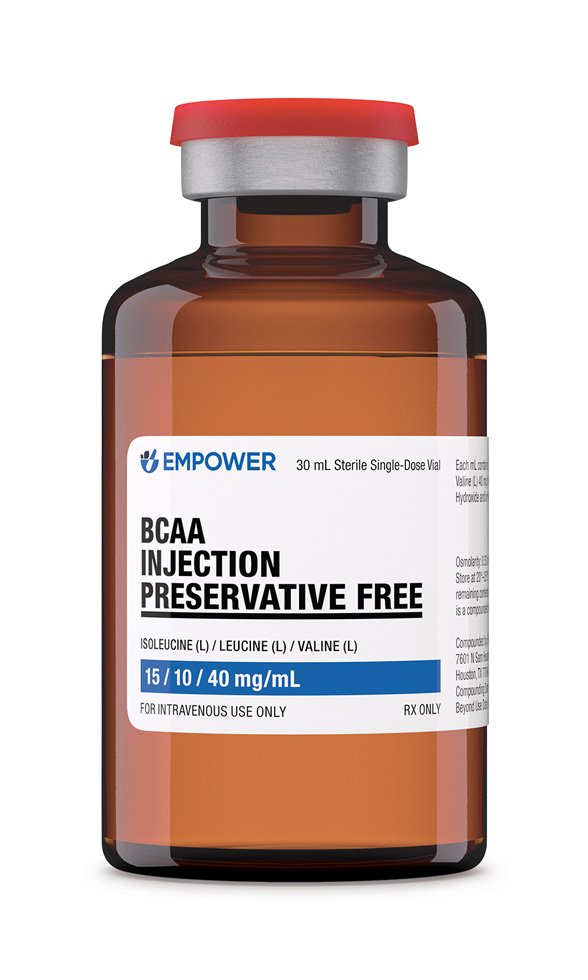
Compounded BCAA Injection delivers these amino acids in a balanced ratio (15 mg/mL isoleucine: 10 mg/mL leucine: 40 mg/mL valine) formulated for intravenous use in patients who cannot meet metabolic requirements enterally, including those receiving total parenteral nutrition (TPN), experiencing catabolic stress, or requiring targeted amino-acid modulation.
Interest in intravenous BCAA therapy emerged from observations that plasma BCAA levels fall in critical illness and liver failure, contributing to sarcopenia, immune dysregulation, and altered neurotransmitter balance. Controlled trials and clinical guidelines have therefore explored BCAA-enriched infusions to restore nitrogen balance and mitigate hepatic encephalopathy, although evidence remains heterogeneous and patient-selection dependent.
Current parenteral nutrition recommendations from ASPEN emphasize the importance of individualized amino-acid profiles, noting that specialized solutions, such as high-BCAA formulas, may improve visceral protein synthesis and clinical outcomes in select scenarios.
When compounded under section 503A, BCAA Injection offers prescribers flexibility in dosing, osmolarity, and preservative content, but must be ordered pursuant to a patient-specific prescription and prepared in compliance with USP <797> standards.
Because compounded BCAA Injection is not an FDA-approved fixed-dose product, dosing must be individualized. Product labeling for commercially available high-BCAA solutions (e.g., PROSOL 20 % or Aminosyn-HBC 7 %) recommends initiating at 1-2 g/kg/day total amino acids (including BCAAs) infused continuously over 8-24 h, with incremental titration based on nitrogen balance, serum amino-acid profiles, and hepatic or renal function.
Clinical trials in hepatic encephalopathy have administered BCAAs at doses providing approximately 0.25-0.35 g/kg/day of leucine equivalents, usually as part of a multi-component TPN regimen; neurological improvement typically requires at least three to seven days of therapy.
Systematic reviews advise that the BCAA fraction should constitute no more than 35-50% of total infused amino acids to avoid amino-acid imbalance while achieving therapeutic plasma ratios.
Leucine is recognized as a potent nutrient signal that activates the mechanistic target of rapamycin complex 1 (mTORC1), thereby initiating translation and promoting skeletal muscle protein synthesis.
Isoleucine complements this anabolic drive by enhancing insulin-independent glucose uptake through AMPK and PI3K pathways, potentially improving substrate utilization in stress states.
Valine contributes to hemoglobin synthesis and serves as a glucogenic precursor, supporting gluconeogenesis during fasting or injury.
At the systemic level, BCAA catabolism begins with transamination via branched-chain amino-acid aminotransferase in skeletal muscle, followed by oxidative decarboxylation through the branched-chain α-keto-acid dehydrogenase complex; dysregulation at either step alters ammonia detoxification and neurotransmitter precursor flux.
Estrogen, inflammatory cytokines, and endocrine factors modulate these enzymatic steps, explaining sex-specific and disease-specific variations in BCAA
requirements.
Importantly, intravenous delivery bypasses splanchnic extraction, achieving higher and more predictable plasma peaks than oral supplementation, which may be advantageous in catabolic or malabsorptive states.
However, supraphysiologic BCAA concentrations can down-regulate insulin signaling and compete with aromatic amino acids at the blood-brain barrier, underscoring the need for cautious titration.
BCAA Injection is contraindicated in patients with inborn errors of branched-chain amino acid metabolism, such as maple syrup urine disease (MSUD), where defective branched-chain α-keto-acid dehydrogenase activity leads to toxic accumulation of both BCAAs and their keto-acids, precipitating neurotoxicity and cerebral edema.
Acute decompensation in MSUD can be triggered by exogenous BCAA loads, making parenteral administration hazardous.
Severe chronic kidney disease imposes additional restrictions; impaired renal clearance of BCAA metabolites may exacerbate uremic symptoms and disturb nitrogen balance despite potential benefits of keto-acid analog therapy.
Patients with advanced hepatic encephalopathy or hepatic coma require nuanced assessment: while BCAAs may improve neurotransmitter ratios, excessive dosing can increase systemic ammonia and worsen encephalopathy if urea-cycle capacity is overwhelmed.
Hypersensitivity to any amino-acid component, uncompensated heart failure requiring fluid restriction, or severe hyperammonemia are further contraindications, as rapid infusion could amplify osmotic load and nitrogen burden.
Elevated circulating BCAAs modulate pancreatic β-cell activity, and intravenous boluses may transiently increase insulin secretion, necessitating glucose monitoring in insulin-treated diabetics.
Case reports describe leucine-sensitive hypoglycemia in individuals with insulin-secreting adenomas, illustrating how exogenous leucine can exaggerate endogenous insulin release.
Pharmacodynamic competition with levodopa at the large neutral amino-acid transporter reduces central levodopa uptake, potentially diminishing anti-Parkinsonian efficacy; separating BCAA infusions from levodopa dosing by at least two hours is advisable.
Concomitant administration with high-nitrogen parenteral substrates (e.g., other amino acid solutions or protein hydrolysates) may increase renal solute load, and prescribers should adjust total daily nitrogen to avoid azotemia.
The most frequently reported adverse effect is transient hyperammonemia, stemming from accelerated BCAA deamination and limited hepatic urea-cycle reserve, particularly in patients with cirrhosis or portosystemic shunts.
Infusion-related complications mirror those of TPN, including catheter-related bloodstream infection, thrombophlebitis, and metabolic derangements such as hypoglycemia, hyperglycemia, or electrolyte shifts.
Localized pain, erythema, or infiltration can occur when compounded solutions exceed recommended osmolarity thresholds; vigilant line assessment and appropriate osmolarity dilution mitigate these risks.
Product labeling for comparable commercial amino-acid injections cites potential acid-base imbalance, azotemia, and elevated liver enzymes, highlighting the importance of baseline and periodic laboratory monitoring.
Human data regarding parenteral BCAA supplementation in pregnancy are limited. Expert consensus discourages routine amino-acid supplementation beyond dietary intake owing to unknown fetal safety, recommending that clinicians prioritize balanced enteral nutrition when feasible.
Observational studies have linked elevated mid-gestational BCAA concentrations to increased risk of gestational diabetes mellitus (GDM), suggesting that excessive exogenous BCAA exposure could perturb insulin dynamics.
Nonetheless, BCAAs play essential roles in fetal protein synthesis, and emerging metabolomic analyses indicate dynamic shifts in maternal BCAA profiles across trimesters, with lower valine and leucine concentrations correlating with suboptimal neonatal growth.
Until robust safety data are available, parenteral BCAA use during pregnancy should be limited to circumstances where anticipated maternal benefits clearly outweigh potential fetal risks, under close metabolic supervision.
Unopened vials should be stored at 20-25 °C (68-77 °F). After the closure is penetrated, aseptic transfer to a parenteral-nutrition container must occur within four hours, and any unused portion discarded. The final admixture should be inspected for clarity, absence of precipitate, and phase integrity before infusion.