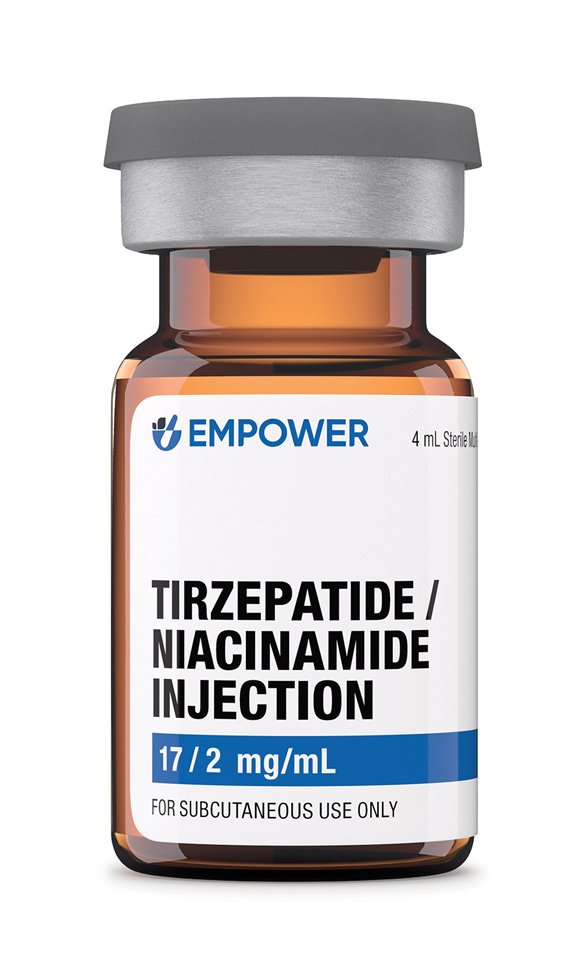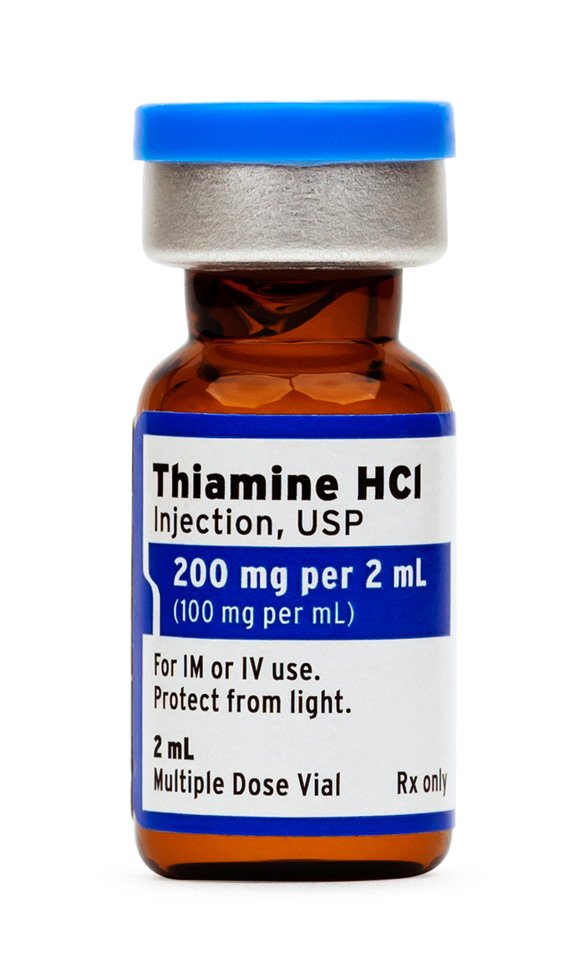
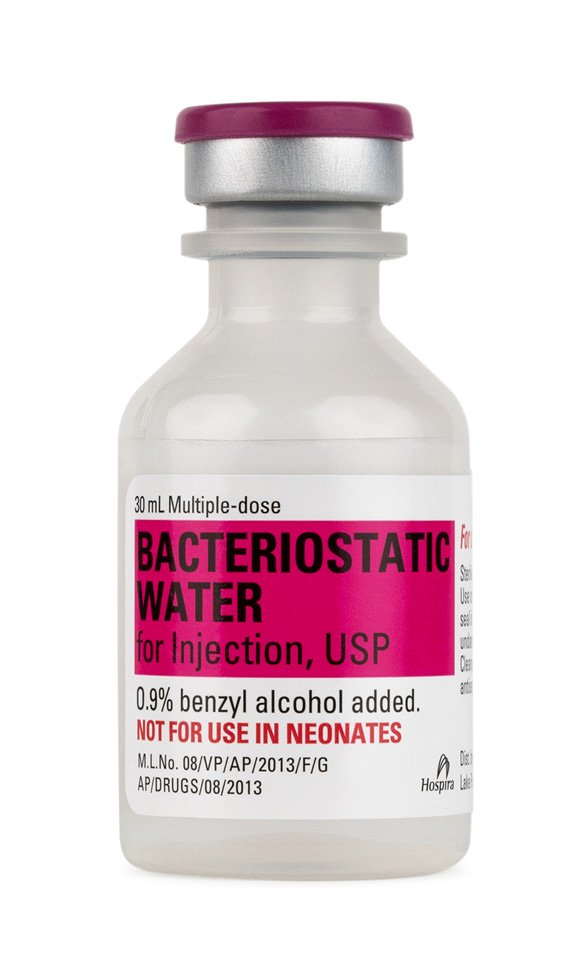
Bacteriostatic Water for Injection is a sterile, nonpyrogenic water solution containing 0.9% benzyl alcohol as a preservative.
It is used as a diluent to dissolve or dilute medications for intravenous (IV), intramuscular (IM), or subcutaneous (SQ) injection according to the instructions of the specific drug being prepared.
Benzyl alcohol acts as a bacteriostatic agent, meaning it inhibits the growth of bacteria in the solution. This allows the product to be supplied in multi-dose vials and used for repeated withdrawals, in contrast to preservative-free sterile water which is intended for single use only.
By preventing bacterial proliferation, bacteriostatic water remains usable for multiple injections from the same vial when handled with proper aseptic technique.
Bacteriostatic Water is not a drug with an independent dosage; it is used only as a solvent or diluent for other injectable medications. The volume of bacteriostatic water required for reconstituting or diluting a medication depends entirely on the instructions provided for that specific medication.
Each drug will have recommended dilution guidelines, for example, a powdered medication vial may specify adding a certain number of milliliters of diluent. The healthcare provider should use only the amount of bacteriostatic water needed to achieve the desired concentration for injection, following the drug manufacturer’s directions.
Using the correct volume ensures the medication is properly dissolved or diluted and delivered at the intended dose. It’s important to mix thoroughly after adding the water to ensure the drug goes completely into solution. After reconstitution, the medication should be administered using the route and rate specified (IV, IM, or SC) per the drug’s guidelines.
Administration Precautions: Bacteriostatic Water for Injection should never be injected intravenously (or intra-spinally) by itself without first being mixed with a medication or appropriate solute. Because it is essentially water without sufficient solute, direct intravenous administration can cause red blood cell lysis (hemolysis) due to its hypotonic nature.
To avoid this, always ensure that the final admixture is approximately isotonic, typically achieved by the drug or other diluents added to the bacteriostatic water, before injecting into the bloodstream. In practical terms, this means bacteriostatic water is only to be used to dissolve or dilute other substances, and the resulting solution should have an appropriate concentration of electrolytes or osmotic agents.
If the manufacturer of a medication specifies a particular diluent (e.g., sterile saline), bacteriostatic water should not be substituted unless approved, and if used, the osmolarity of the mixture must be considered.
By adhering to these precautions, one can safely use bacteriostatic water to prepare injections without causing harm from the diluent itself.
Bacteriostatic Water has no direct pharmacological action on the body; its purpose is to safely deliver other medications.
The inclusion of benzyl alcohol (at 0.9%) imparts an antimicrobial effect by inhibiting bacterial growth and reproduction in the water. This bacteriostatic (growth-inhibiting) property, rather than a bactericidal (bacteria-killing) effect, ensures that any contaminating microbes do not multiply.
As a result, a single vial of bacteriostatic water can be used for multiple dose preparations over time (up to 28 days after opening) without significant risk of
contamination.
The water itself simply serves as a solvent or vehicle for the drug and does not alter the drug’s mechanism of action.
Neonates: Bacteriostatic Water for Injection is contraindicated in neonates (newborn infants), especially premature infants. The benzyl alcohol preservative has been linked to severe toxicity in this population, including a potentially fatal condition known as “gasping syndrome.” Newborns have immature metabolic pathways and cannot efficiently metabolize benzyl alcohol, leading to its accumulation and metabolic acidosis with respiratory failure in severe cases.
Therefore, solutions containing benzyl alcohol must not be used for preparing medications for neonates; if a diluent is needed for an infant, preservative-free sterile water for injection should be used instead.
Additionally, use of bacteriostatic water is contraindicated in any patient with a known hypersensitivity to benzyl alcohol, as it could provoke an allergic reaction in such individuals.
Patients with benzyl alcohol allergy should not be exposed to this diluent.
Route-specific and Other Contraindications: Bacteriostatic Water must not be used for large-volume intravenous fluid replacement or hydration therapy. The formulation is intended only for diluting medications in small quantities; using it as an IV infusion or flush solution could result in excessive benzyl alcohol intake.
It is also contraindicated for epidural or spinal (intrathecal) injection procedures. Preparations containing preservatives should not be introduced into the cerebrospinal fluid due to the risk of neurotoxic effects on neural tissue. If a medication is to be administered via the intrathecal/epidural route, only preservative-free diluents (such as sterile saline or sterile water) are appropriate.
In summary, Bacteriostatic Water for Injection should only be used as directed to dilute or dissolve drugs for injection, and it must be made approximately isotonic with the added medication or solution prior to intravenous administration.
Injecting bacteriostatic water alone, without dilution, or in large volumes, is dangerous and therefore contraindicated.
Bacteriostatic Water for Injection does not have traditional drug-drug interactions since it contains no active pharmaceutical ingredient; however, there are important compatibility considerations when mixing it with other drugs.
Some medications may be incompatible with bacteriostatic water or with the benzyl alcohol preservative. For example, certain biological products or drugs (like some vaccines or delicate protein-based drugs) should not be reconstituted with bacteriostatic water because the preservative could interfere with the drug’s stability or efficacy.
Always consult the medication manufacturer instructions for dilution requirements and compatibility. If there is any uncertainty, a pharmacist should be consulted to determine the appropriate diluent.
In practice, many drug vials will specify if they must be reconstituted with sterile water or saline instead of bacteriostatic water. Following these guidelines is crucial, as using an incompatible diluent could cause precipitation of the drug or inactivation of the drug’s therapeutic effect.
When used properly as a diluent, bacteriostatic water itself has minimal side effects in most patients. It is an inert vehicle, so any adverse effects are usually related to the act of injection or the medication being administered rather than the diluent.
Common local reactions may include mild pain, redness, or swelling at the injection site. Improper technique or contamination can lead to more serious localized issues such as injection site infection, abscess formation, tissue necrosis, or thrombophlebitis (vein inflammation). These injection-site reactions are generally due to mechanical irritation or microbial contamination.
Systemic side effects from the tiny amount of benzyl alcohol in each dose are exceedingly rare in adults. Notably, newborn infants are at risk of severe toxicity (as discussed in Contraindications), but in adults and older children, the small benzyl alcohol dose is very well tolerated.
If fever, chills, or other unexpected systemic reactions occur during an injection, it is likely due to the drug being delivered or possible contamination, rather than the bacteriostatic water itself. Any such adverse reaction should be evaluated by a healthcare provider.
There are no adequate studies of bacteriostatic water in pregnant women, and its effects on reproduction are not well-studied.
Bacteriostatic Water for Injection is pharmacologically inactive aside from the preservative, but the safety of benzyl alcohol in pregnancy has not been established. Animal reproduction studies on bacteriostatic water (with benzyl alcohol) have not been conducted, so its potential to cause fetal harm is unknown.
For this reason, bacteriostatic water-diluted medications should be used during pregnancy only if clearly needed and if the potential benefit justifies any potential risk to the fetus.
Healthcare professionals often exercise caution and may opt for preservative-free diluents in pregnant patients when possible, especially if large volumes of diluent are required.
Benzyl alcohol can cross the placenta and is also likely excreted in breast milk in small amounts. While the exposure from bacteriostatic water is very low, there is a theoretical risk that an infant could ingest benzyl alcohol through breast milk.
In practice, using bacteriostatic water as a diluent for a single-dose medication in a nursing mother is unlikely to pose significant risk, but caution is still advised. If repeated injections (containing bacteriostatic water) are required in a breastfeeding mother, healthcare providers will consider the potential accumulation of benzyl alcohol.
As with pregnancy, an alternative preservative-free diluent may be preferred for nursing mothers if feasible.
Ultimately, decisions on using bacteriostatic water during pregnancy or lactation should involve a risk-benefit assessment by the physician, and therapy should be monitored closely.
Unopened vials of Bacteriostatic Water for Injection have a long shelf life, usually on the order of 2-3 years from the date of manufacture (check the expiration date on the vial).
They should be stored at controlled room temperature, typically around 20°C to 25°C (68°F to 77°F), and kept in a clean, dry place. It is important to protect the vials from excessive heat and direct sunlight during storage, as extreme conditions could potentially degrade the product or its packaging.
The vial should remain sealed and sterile until it is ready to be used. Do not use the solution if you notice any cloudiness, particulate matter, or discoloration, as these could indicate contamination or compromise of the sterile seal.
Under proper storage conditions, an unopened bacteriostatic water vial will remain stable until its printed expiration date.